Owl Editing, Vancouver


FAQ Fees Contact Search
bar


Subscribe to the Owlette Gazette, the ezine for students and writers. Just enter your email address below and click on the Subscribe button.

HTML

text


newsletter


 Understanding the meaning of poetry


Prose is when all the lines except the last go on to the end. Poetry is when some of them fall short of it.
Jeremy Bentham (1748-1832)


 Structure


Form: Ballad, Concrete, Elegy, Epic, Free Verse, Haiku, Lyric, Ode, Sonnet, Villanelle, Slam
Stanza pattern:  Couplets, Triplets, Quatrains, etc.
Rhyme Schemes:ABAB;  ABA, ABA;  AA;  etc.
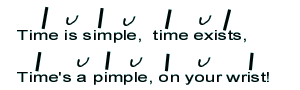
Rhythm: The "flow" of the poem. Does the poem have a regular "beat?"
Iambic: unstressed;  stressed
Trochaic: stressed;  unstressed
Anapestic: stressed;  unstressed; unstressed
pattern of stresses
Line length:
monometerdimetertrimeter
tetrameterquatrameterpentameter
Enjambment:When the idea or grammar does not stop naturally at the end of the line but flows into the next line without a pause.
Catalectic:To stop short.
Caesura:A special kind of pause, usually in the middle of a line.
    I don't care too   much for money,
    Money can't buy me love.

SOUND CLIP

poetry samples


top of page top of page


 Figures of speech


Connotation:An idea associated with a word or phrase.
Denotation:The explicit meaning of a word
Hyperbole:Exaggeration used for effect.  "tons of money", "a million thanks,"
Origin of the word.
Imagery:What do you see in the poem?
      Whirl up sea --
      whirl your pointed pines
    (the image of a forest of pine trees
     swaying back and forth like the
    cresting waves of a stormy sea.)
Irony: One thing is said, but the opposite meaning is intended.
Metaphor: A comparison without "like" or "as".
    Where were the greenhouses going,
    Lunging into the lashing
    Wind driving water
    So far down the river
    All the faucets stopped?
Metonymy: A person or thing is not named directly, but by some associated thing.
    The prisoner addressed the bench.
Motifs:Ideas, or elements that recur throughout the poem.
Oxymoron:Words with opposite meanings.
tight slacksOld New Yorkbitter-sweet
sweet sorrowgood griefsanitary landfill
Paradox:A statement, which at first, seems contradictory or absurd.
Personification:Human qualities are attributed to an animal, object, or idea.
    I am silver and exact.
    I have no preconceptions.
    Whatever I see I swallow immediately
    Just as it is, unmisted by love or dislike.
    I am not cruel, only truthful--
Pun:Words with a double meaning.
    A bear walks into a bar and says:
      "How about a gin and ......................
      .......................................... tonic?
    The bartender asks:
              "What's with the big pause?"
    The bear replies:
                "Just born with them, I guess."
Repetition: A word or phrase is used more than once for emphasis.
    See the flags; snow-white tent,
    See the bear and elephant,
    See the monkey jump the rope,
    Listen to the Kallyope, Kallyope, Kallyope!
Simile:A comparison using "like" or "as".
      her lower lip
      was like an orange
      mint. and
      i was a crying
      little boy
      in the candy store.
Synechdoche:A part represents the whole.  A fleet of a hundred sail.
Symbolism:Something that stands for something else. (Myths & Legends)

poetry samples


top of page top of page


 Sound devices


Alliteration:Two or more words in close succession beginning with the same letter or sound.

I caught this morning morning's minion, kingdom of daylight's dauphin, dapple-dawn-drawn Falcon,
in his riding
Assonance:Repetition of vowel sounds:
    Presume not on thy heart when mine is slain;
    Thou gavest me thine, not to give back again.
Consonance:Repetition of consonant sounds:
    You crash over the trees,
    You crack the live branch:
    the branch is white,
    the green crushed,
    each leaf is rent like split wood.

    "bra" and "cr" mimic the sound of
     branches cracking."sh" and "ch"
     imitate the sound of wind and rain.

Onomatopoeia:The word imitates the sound associated with an object or action.
    crack, splash, squeak, creak,
    ding dong of the bells,
    pitter patter of raindrops, buzzer,
    the gong, murmuring, etc.

poetry samples


top of page top of page


 Interpreting meaning


PLAIN SENSEusing just the words and punctuation.
FEELINGawe, tenderness, anger, amusement, etc.
TONEAttitude towards the reader:  confidential, appealing, etc.
INTENTIONWhat is the poet trying to say?
SUBJECTlove, death, family, nature, the city, the country, age, youth, war, civilization, pestilence
THEMEbetter to have loved and lost... respect your elders... absence makes the heart grow fonder... the rolling stone gathers no moss... etc...
MORALIs some kind of a lesson being taught?
poetry samples


top of page top of page


Copyright ©1996-2007 by Glen Wheeler
Owl Editing, Grey Owl Tutoring, Canada. All Rights Reserved.
Last updated:  10 April, 2007